

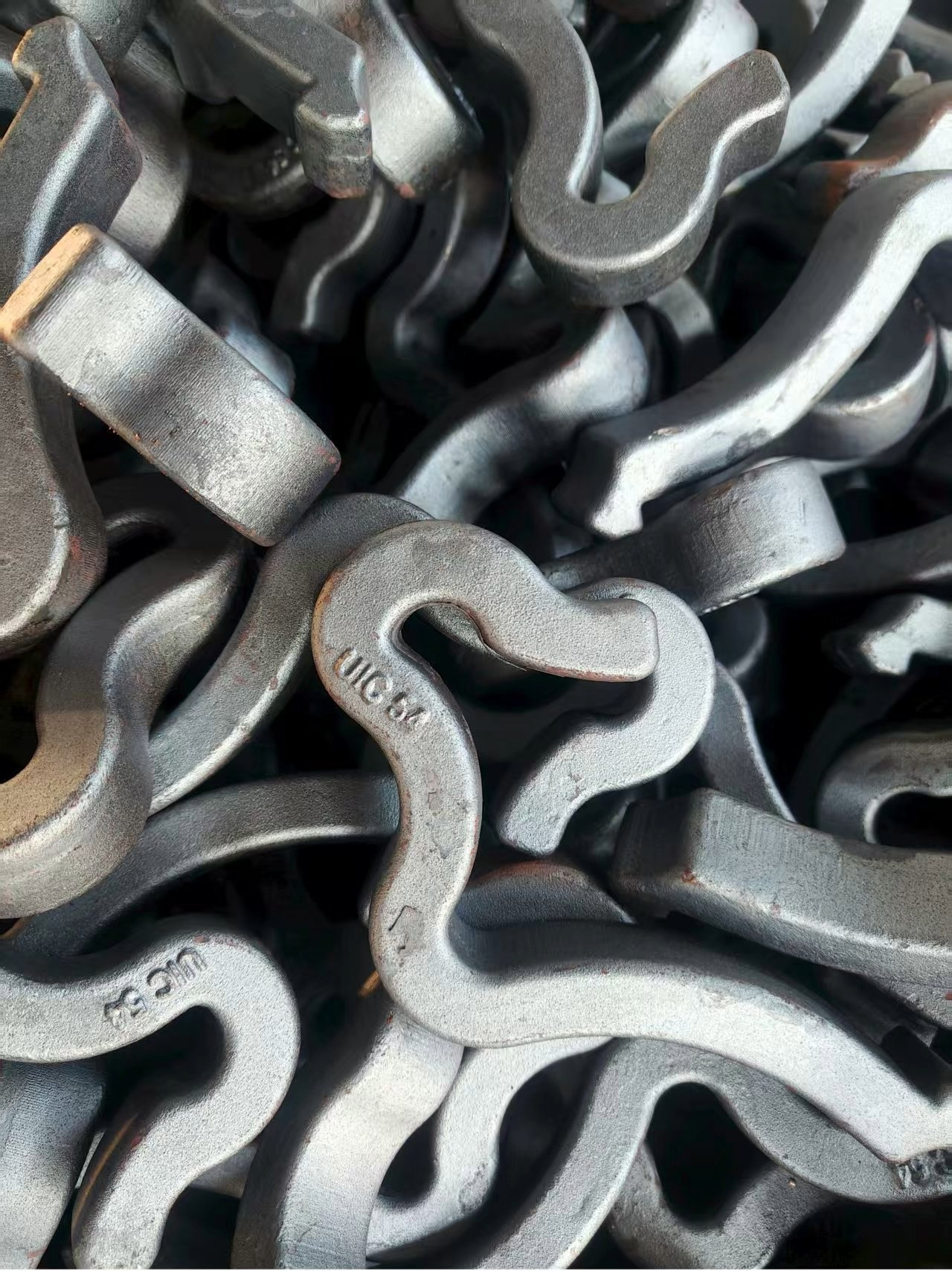
Railroad fasteners are small components with oversized consequences. Rail anchors, elastic clips, tie plates, and joint bars are the interface between rail and support where vertical loads, lateral forces, and longitudinal forces are transferred and controlled. If that interface is poorly designed, inconsistently manufactured, or weakly inspected, the outcomes are predictable: instability, accelerated wear, maintenance escalation, and safety risk.
This guide is written for North American procurement and engineering teams who source railroad fasteners aligned to AREMA recommended practices. It explains what “AREMA-aligned” practically means, why restraint and fatigue matter, and what documentation you should require from any supplier before approving a fastener for service.
1) What AREMA Means in Track Fastener Procurement
In North America, many track owners, consultants, and contractors reference AREMA because its Manual for Railway Engineering (MRE) is a central set of railway engineering reference material and recommended practices. The MRE is published annually and contains principles, specifications, and design guidance for the fixed plant of railways.
AREMA also defines “recommended practice” in its manual as a material/device/design/specification/principle recommended to railways, either used as presented or modified for a railway’s needs, with the intent of promoting consistent engineering practice.
Procurement implication: When a supplier claims “AREMA,” buyers should interpret it as:
- The product is designed and validated in alignment with applicable AREMA guidance, and
- The supplier can produce objective evidence (inspection/test documentation) that the delivered goods meet the stated acceptance criteria and traceability requirements.
2) Why Rail Fasteners Matter: Restraint, Creep, and Load Management
A “rail fastening system” is not only about holding rail down, it is intended to resist lateral and longitudinal movement, restrain rail rotation, and provide vertical support; resilient assemblies can also help with insulation and vibration filtering.
One key performance requirement is longitudinal restraint—controlling rail creep. Industry engineering literature notes that controlling rail creep is important for multiple reasons, including constraining CWR under temperature variation, limiting movement under traction/braking forces, and protecting special trackwork and joints from excessive longitudinal forces.
Procurement implication: If you are sourcing rail anchors, clips, and plates, you are sourcing a restraint system. The right questions are therefore not only “what is the price,” but “what is the proven performance and consistency of restraint, toe load, fatigue resistance, and dimensional conformance.”
3) The Core Components Buyers Verify
A) Rail Anchors (Anti-Creepers): Purpose and Verification
A rail anchor (anti-creeper) is defined as a track device designed to prevent longitudinal rail movement (creep) caused by factors such as traffic or temperature variations.
What buyers should verify:
- Geometry fit (rail section compatibility): Ensure the anchor design matches the rail profile and base geometry used in your project.
- Material and heat identification: Lot/heat traceability that connects shipped items to material certification.
- Consistent restraint characteristics: Anchors are restraint devices—buyers should request the supplier’s internal acceptance method and evidence for consistency (e.g., dimensional checks, hardness checks, and any restraint-related validation the supplier can provide).
- Coating and corrosion protection (if applicable): Particularly important for storage and harsh environments.
Common failure risk to screen for: uncontrolled variation—anchors that appear correct but differ materially across lots can create unpredictable restraint behavior.
B) Elastic Rail Clips (E-Clips): Toe Load and Fatigue Matter
Research literature describes the rail clip as a critical component that applies compressive force (toe load) and maintains the rail in vertical, lateral, and longitudinal positions. It also notes that correct function depends on specified toe load at installation, and that clips experience combined static and cyclic loading, which can lead to fatigue failure.
What buyers should verify:
- Toe load / clamping-force intent: How the supplier specifies and controls the clip’s load characteristics (and how they validate it).
- Fatigue resistance: Clips operate under repeated loading; buyers should request evidence the clip design and production are suitable for cyclic stress environments.
- Material, heat treatment, and hardness window: The supplier should document how they ensure stable spring properties across lots.
- Dimensional conformance: Small geometry differences can change clip behavior and installation outcomes.
Procurement note: For elastic components, you are buying performance consistency as much as you are buying steel.
C) Tie Plates / Base Plates: Load Distribution and Interface Control
Tie plates/base plates manage the interface between rail and sleeper and are key to geometry control and load distribution. Because the plate is a foundational interface component, procurement should treat it as a dimensional control item, not a commodity.
What buyers should verify:
- Dimensional and hole-position accuracy: Plates are often drilled/formed for specific fastening systems.
- Rail seat geometry and fit: Ensures correct rail seating and fastener interaction.
- Material certification and traceability: Especially for critical applications and for consistent performance across lots.
- Surface condition and coating (if specified): To reduce handling corrosion and ensure proper seating.
D) Joint Bars (Fishplates): Alignment, Strength, and Repeatability
Joint bars transfer loads across rail ends and require reliable geometry and bolt-hole alignment. In procurement, joint bars should be treated as a safety-critical part: dimensional accuracy, material conformance, and traceability are non-negotiable.
What buyers should verify:
- Profile match for the rail section
- Hole alignment / drilling tolerances
- Material certification and traceability
- Inspection evidence for each lot
4) The “Conformance Pack” Every Supplier Should Provide
If you want suppliers who hold up under audit conditions, standardize your purchasing process around a Conformance Pack. At minimum, request:
- Material Test Report (MTR) / Mill certificates
- Heat/lot traceability statement (how heat numbers map to shipped lots)
- Dimensional inspection report (critical dimensions, sampling plan, date, inspector)
- Hardness or mechanical verification (when relevant to the product family)
- Coating/finish documentation (if specified)
- Packaging/labeling confirmation (lot labels, quantity, corrosion prevention method)
This approach reduces supplier disputes and protects your maintenance team from mixed-lot inconsistencies later.
5) Supplier Evaluation: How to Separate “Claims” From “Capability”
A practical way to qualify fastener suppliers is to audit the following:
Manufacturing control
- Documented process control (incoming material checks → in-process inspection → final inspection)
- Defined acceptance criteria for critical dimensions and properties
Testing and inspection discipline
- Evidence that inspection is systematic and traceable
- Calibration approach for measuring instruments (hardness testers, gauges, etc.)
Traceability and accountability
- Can the supplier map shipped goods back to a heat/lot, and produce supporting records without delays?
Transparency
- Will the supplier provide sample documents and clearly state what is included with every PO?
6) RFQ Checklist You Can Copy Into Your Next Purchase Request
Include this in your RFQ email or portal request:
- Product type: rail anchor / elastic clip / tie plate / joint bar / other
- Rail section / profile: (e.g., 115RE, 136RE, etc.)
- Application: mainline, heavy haul, industrial track, special trackwork, etc.
- Quantity and delivery schedule: first lot + annual demand estimate
- Required documentation: Conformance Pack (MTR, inspection report, traceability)
- Any required coatings/finishes: (if applicable)
- Packaging requirements: palletization, labeling, corrosion protection
- Quality expectations: lot segregation, traceability, NCR handling process
7) Frequently Asked Questions
Q1: Does “AREMA” mean the product is automatically approved for all railroads?
No. AREMA provides widely used recommended practices and reference material, but individual railways and agencies may have additional requirements, qualification steps, or approved vendor lists.
Q2: Why do clips and anchors often fail in service?
Because restraint components see repeated static + cyclic loading, and fatigue risk increases with stress concentration, installation variability, and inconsistent material/heat treatment.
Q3: What is the simplest way to reduce procurement risk?
Standardize a Conformance Pack requirement and enforce lot traceability. If a supplier cannot provide it quickly and consistently, that is a material risk.
Final Takeaway
If you source railroad fasteners as commodities, you will eventually pay for that decision in maintenance complexity and risk. If you source them as engineered restraint and interface components—validated by documentation, traceability, and consistent inspection—you greatly improve operational confidence.
If you would like, StarPath can provide a standard Conformance Pack with each shipment and supply samples of typical documentation during RFQ so your team can evaluate it before placing an order.